 Bioicus
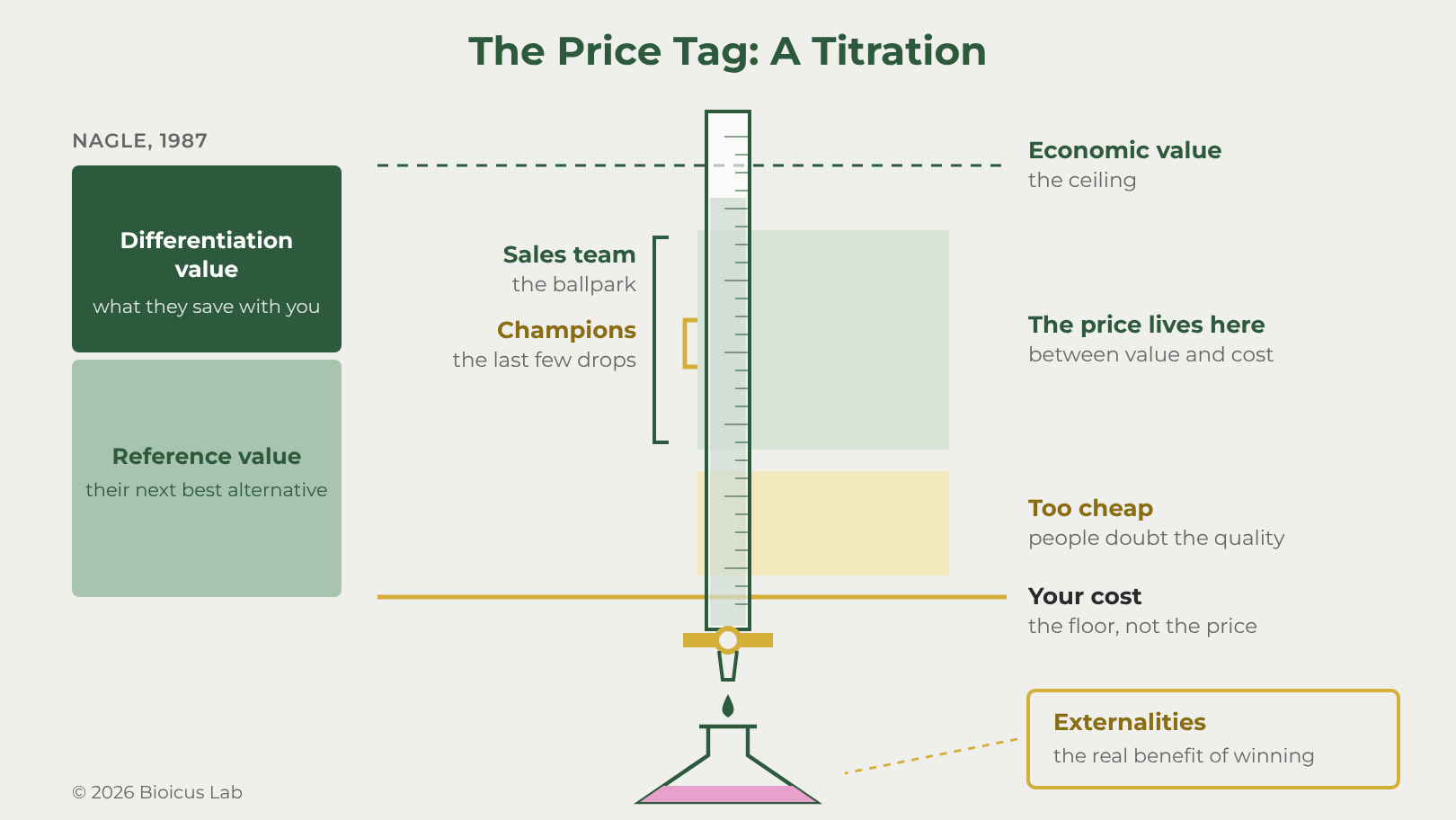
In my early undergraduate days as a Medical Technologist, I remember how frustrated I was with one exercise: a pH titration with phenolphthalein. Only when I mastered the delicacy of the valve could I stop at the first faint magenta that stays, a shade we all recognise from culture media.
Fortunately, in that exercise the microlitres coming out of the burette were the only variable to consider.
Later in my career, an important opportunity came along to win a big customer. I felt nervous. Following the standard calculation, cost plus margin, the price was quite right. But I didn't count the externalities of having that customer with us: prestige, business continuity, a way into the community. We lost the contract. To this day I feel that because I followed the calculation, I never sized the real benefit of winning it.
The maths was right. The flask was too small.
In business, unfortunately, it isn't that easy. Cost plus margin treats the deal like the flask: one variable, one endpoint. The market around it has many more.
Thomas Nagle put a better calculation on paper in 1987, in The Strategy and Tactics of Pricing. Price from the customer's side: start with what their next best alternative costs them, then add what your product does that the alternative doesn't, in money. That's the ceiling. Your cost is the floor.
But the floor isn't only your cost. If the price is too cheap, it doesn't sell either, because people assume the quality can't be good. That's like not opening the burette enough: the flask never changes colour.
Peter van Westendorp built that doubt into his Price Sensitivity Meter in 1976. One of its four questions asks at what price a product is so cheap that you would feel the quality couldn't be very good. In 2008, a study in JAMA gave 82 volunteers the same placebo painkiller, presented at $2.50 or at 10 cents a pill. Those told it cost more reported less pain: 85% of the full-price group felt relief, against 61% at the discount. Same pill. Different price. Different result.
Trust the sales team on the ballpark. Champions are the last few drops.
Today, working with a client, the same question came back: how to price a new application their R&D team is developing.
My first step is to talk closely with the field sales team. They are the first voice that can help you fine-tune a list price. Not only because they can smell how ready customers are to buy, but because they also see how the competitive landscape behaves. Then I identify around three champions, show them the price and gauge their appetite.
Another thing I have used is calculating what the customer saves if they buy the product or service from us: the cost and the time they gain by doing it with us. Only recently I realised this is exactly what Nagle called differentiation value.
Note: champions are fans of your brand, so their yes comes more easily than a stranger's. If they like the price, it may still be a little high for the wider market. If they find it expensive, it almost certainly is.
Is pricing an art? A science? Well, the more data points you get, the less subjective it becomes. Maybe next time I'll use a servo-assisted robotic arm to open the valve of the burette to a fraction of a microlitre.
This article is part of a series on strategic frameworks for life sciences innovation. Previously: The obligate mutualist: customer concentration as coevolution.
References:
Nagle, T.T. (1987). The Strategy and Tactics of Pricing: A Guide to Profitable Decision Making. Englewood Cliffs, NJ: Prentice-Hall.
van Westendorp, P. (1976). NSS Price Sensitivity Meter (PSM): A new approach to study consumer perception of prices. Paper presented at the ESOMAR Congress.
Waber, R.L., Shiv, B., Carmon, Z. and Ariely, D. (2008). Commercial features of placebo and therapeutic efficacy. JAMA, 299(9), pp. 1016–1017.