 Bioicus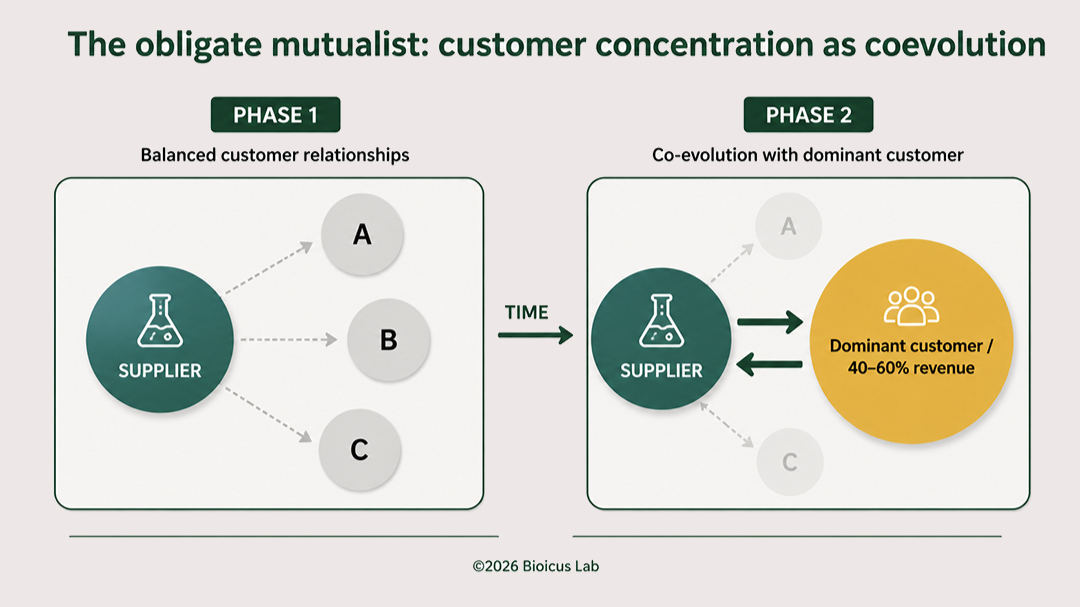
Similar behaviours in two very different environments, to preserve and favour the easy acquisition of energy. First in the lab, studying how organisms co-evolve with their ecological partners until neither can survive without the other. Then, in commercial life sciences, seeing the exact same dynamic play out between the commercial team of a supplier firm and its most important customer.
The biology term is obligate mutualism. Two species so interdependent that separating them isn't just difficult, it's existentially threatening to both. The fig and its wasp. The orchid and its single pollinator. Bacteroides thetaiotaomicron and the human gut. Perfectly optimised. But the interaction is completely fragile.
Here is what actually happens in business. A significant customer arrives. The relationship deepens. Your product roadmap quietly bends towards their workflows. Your pricing reflects their volume. Your support model calibrates to their expectations. None of this is a conscious decision. It is organisational physics.
The dangerous part is that it feels like success. And for a long time, it is.
Your best client is your biggest risk
But life sciences markets are not stable. Consolidations, procurement restructuring, new CSOs with established supplier preferences, funding cycles that redirect entire R&D programmes, shifting regulatory frameworks, new administrations that rewrite reimbursement policy overnight — the environment changes constantly, and often without warning. The question is never whether your dominant customer relationship will be disrupted. It is when.

I know this tension personally. Early in a new venture, the instinct is to protect what you have. One good client changes everything — the cashflow, the confidence, the proof of concept. And yet that instinct, entirely rational in the short term, is precisely how the co-evolution begins.
The practical intervention I have seen — and I am pushing myself to use it — is deliberately uncomfortable. You build a parallel view of the business where that client does not exist, and you run your commercial development against that number. Not because you want to lose them. Because you need to develop commercial capability that is genuinely independent of the relationship you already have.
In systems biology, resilience is not a property of individual components. It is a property of network diversity. Ecosystems with a single dominant species are productive but brittle. Your revenue network is no different.
Apply it to your next revenue review
Next time you review your revenue breakdown, ask:
- If your largest customer disappeared tomorrow, what would your commercial pipeline actually look like?
- Has your product roadmap been shaped by their specific workflows rather than by the broader market?
- Are you tracking new customer development against a baseline that excludes concentrated revenue?
Brilliant science, and brilliant service, deserves a more resilient commercial ecosystem than a single obligate partner.
Reference: Johnson, S. (1998). Who moved my cheese? An amazing way to deal with change in your work and in your life.