 Bioicus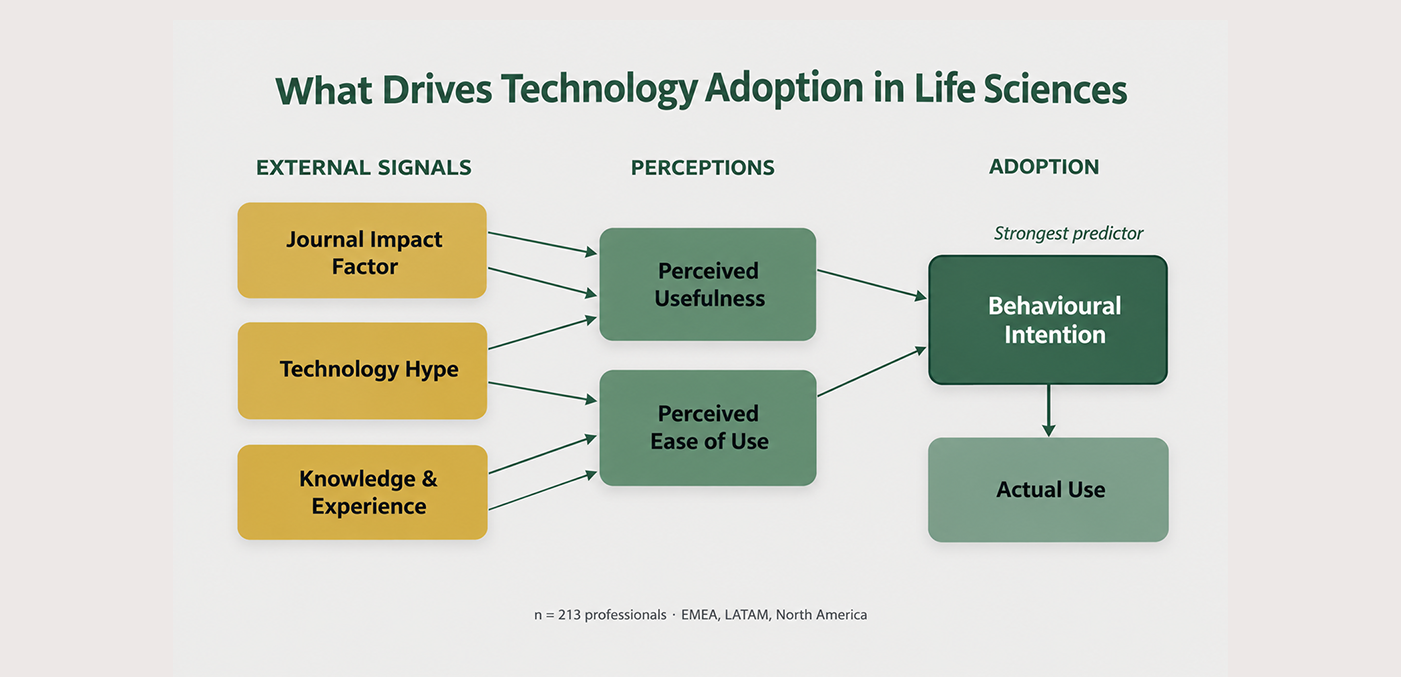
Back in 2022, just before the release of ChatGPT 3.5, I asked a question that had been bothering me for years: everyone in the life sciences was talking about machine learning, but who was actually using it? Not talking about it at conferences. Not writing grant applications that mention it. Actually using it to make decisions.
So I surveyed 213 professionals across EMEA, LATAM, and North America for my MBA dissertation at Winchester. Biotechnology, primary research, healthcare, pharmaceuticals. 77% held postgraduate degrees, and 57% held doctorates. The United Kingdom and Chile made up the two largest groups, for obvious reasons.
I built the study on the Technology Acceptance Model, a framework that has been around since the 1980s and holds up remarkably well. The core idea is simple: whether someone adopts a technology depends on how useful they think it is, and how easy they think it will be. Everything else flows from there. But I added three variables that nobody had tested in this context, and those are where the interesting findings live.
Prestige is a technical requirement
The first external variable was the journal impact factor. I wanted to know whether the prestige of where ML research gets published influences whether professionals trust it enough to use it.
It does. Significantly.
This makes uncomfortable sense once you sit with it. When most of your audience holds a research degree, they have spent a decade being trained to evaluate claims by where those claims appeared. That instinct does not switch off when the subject changes from immunology to algorithms. A method published in a high-impact journal carries an implicit quality signal that a preprint or a vendor white paper does not, regardless of whether the underlying maths is identical.
For anyone commercialising a computational tool in this sector, that is not a marketing insight. It is a product requirement. Publishing in traditional academic outlets remains a must for commercial innovation in our field.
Hype works, and it works in your favour
The second variable was technology hype, borrowed from the Gartner cycle. I hypothesised that peer and competitor noise influences adoption intent, and it does.
What surprised me was the shape of the perception. Gartner had ML sliding into the trough of disillusionment around that time. My respondents did not agree. Only 3% reported disillusionment in their field. The rest split between those who saw the technology as early stage and those who saw it as growing or already hyped.
There was a valley in the data, but it was not the one the industry expected. Life sciences runs on a different clock than general IT. The hype cycle that applies to enterprise software does not map cleanly onto a sector where a single validation study takes 18 months.
Healthcare is ahead of academia, not behind it
The one professional split that showed a meaningful difference: healthcare professionals perceived ML as more mature in their field than academic researchers did. The clinicians were not the laggards. They were further along. Possibly academics over-scrutinise before adopting.
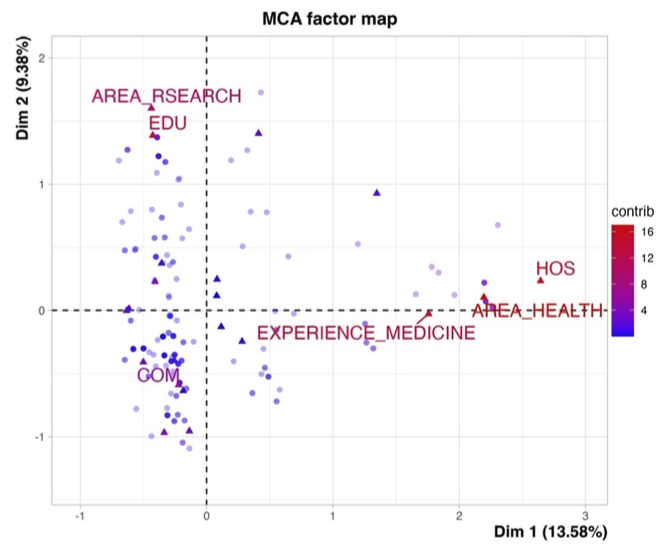
MCA factor map of respondents. Qualitative factors: occupation area, field of expertise, and organisation type. The highest contributors are shown. HOS: hospitals; EDU: educational.
Geography, on the other hand, explained almost nothing. A doctorate in Santiago and a doctorate in Oxford approached the technology in essentially the same way. The adoption curve across the Western Hemisphere is far more uniform than the industry assumes when it builds regional go-to-market strategies.
The part that changed how I work
Behavioural intention to use turned out to be the strongest construct in the model. Not actual capability. Not prior experience. Intention.
Which means adoption in life sciences is mostly a trust problem wearing a technical costume. The prestige signal, the peer noise, the workflow that either accommodates the tool or quietly rejects it. These decide the outcome long before anyone evaluates the model's performance.
Companies building computational products in this sector optimise the algorithm and treat everything else as someone else's job. The data says everything else is the job.
This research was conducted as part of Antonio Serrano's MBA dissertation at the University of Winchester Business School. The full dataset is openly available on Harvard Dataverse, and the preprint is freely available on medRxiv.