 Bioicus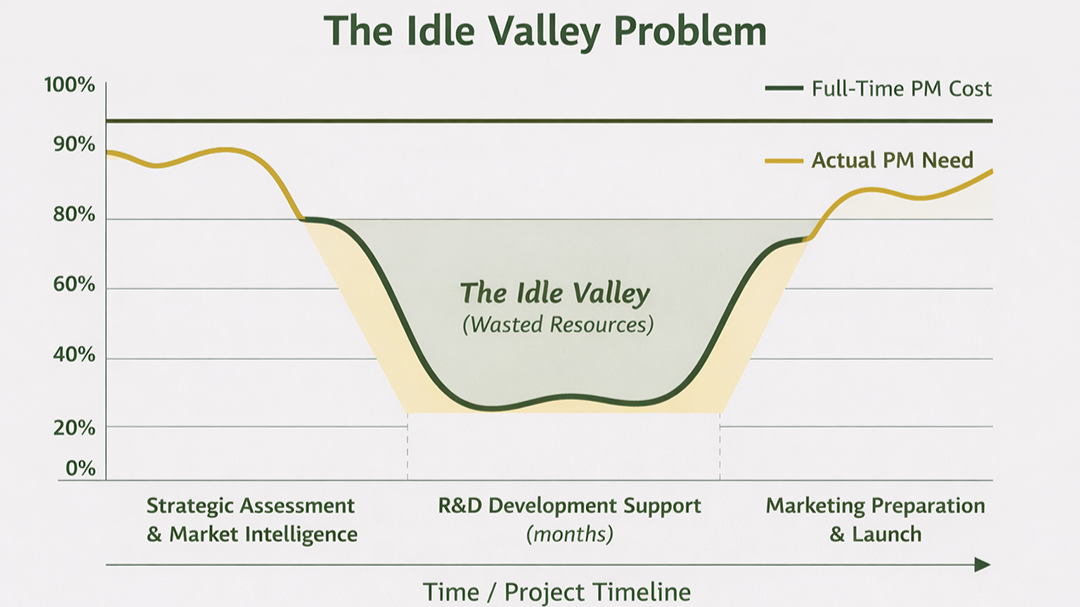
I have seen it happen. A life sciences spinout secures funding. The technology or asset looks promising, and convinced investors want commercial readiness ASAP. So they hire a qualified Product Manager. Then reality hits: the next 8 months are pure bench R&D. Experiments. Waiting. Iteration.
Cells take time to grow. Patient samples take months to collect a significant number. Instruments acquire data quickly, but terabytes accumulate without analysis. The next funding round is approaching rapidly. You have fought so hard to get here, and the continuation has a big IF.
That Product Manager? Often underutilised through no fault of their own. Writing decks on imaginary data. Creating a buzz about something amorphous. Building strategies for products still in validation. The cash is burning. The investment isn't matching.
I call this The Idle Valley. It's the gap between what your biological venture is paying for and what you actually need. The real need is rhythmic, requiring intense bursts during strategic phases but minimal activity during long R&D cycles. A flat investment when starting lean doesn't fit.
Modern product management frameworks work great in digital businesses. Agile cycles are intense, and within weeks, a new round of iterations requires fresh strategic insights. In life sciences, this bio-reactor scaling can take months to produce the first batch.
Most early-stage life science ventures face a painful choice:
- Hire too early and burn cash on idle capacity during 8-month experiments.
- Hire too late and miss the commercial window while your investors demand results.
Neither option works. Both would jeopardise the commercial journey of great science.
In one of my earliest roles, the CSO chose the second. Scientific literature was solid, and world-class evidence supported it. The product was ready, but there was no go-to-market strategy. How could we fail to get into the market if our product is so fantastic? The result was months of costly production machinery sitting idle before manufacturing began due to no demand. A close-up experience of scientists spending the best years of their lives building products without knowing whether anyone actually needed them.
The Idle Valley isn't just about Product Management. It's about the fundamental mismatch between how biotech R&D actually works and how traditional hiring models operate. R&D has a rhythm. Standard hiring models assume a flat line.
If you're leading an early-stage life science company, ask yourself: Are you paying for flat capacity when you need burst intensity? Is your £100K product strategy investment matching your R&D reality? Or is the precious capital getting lost in The Idle Valley, keeping you up at night?
The solution isn't revolutionary. It's rhythmic.
The Product BioRhythm
Fractional Product Management. Strategic guidance that matches the natural rhythm of your R&D cycles. Expert support precisely when critical decisions are made, not a constant overhead draining resources during quiet phases. Think of it as intensity when you need it, silence when you don't.
The approach follows your venture's natural phases. Strategic assessment and market intelligence at the front, when direction matters most. Lighter support during R&D development, when scientists need room to focus on doing what they do best. Then intensity returns for marketing preparation and launch, when commercial timing becomes critical again.
Over the following weeks, I will share what this would look like in practice, how the Technology Readiness assessments reveal where you actually stand, and how the Week of R&D-to-Market Alignment works and why fractional beats full-time for ventures still finding their rhythm.
If any of this resonates, I'd welcome the conversation. The Product BioRhythm diagnostic is one way to start, but honestly, I'm also refining these ideas and value the exchange.
Brilliant science deserves better strategy, better timing.