 Bioicus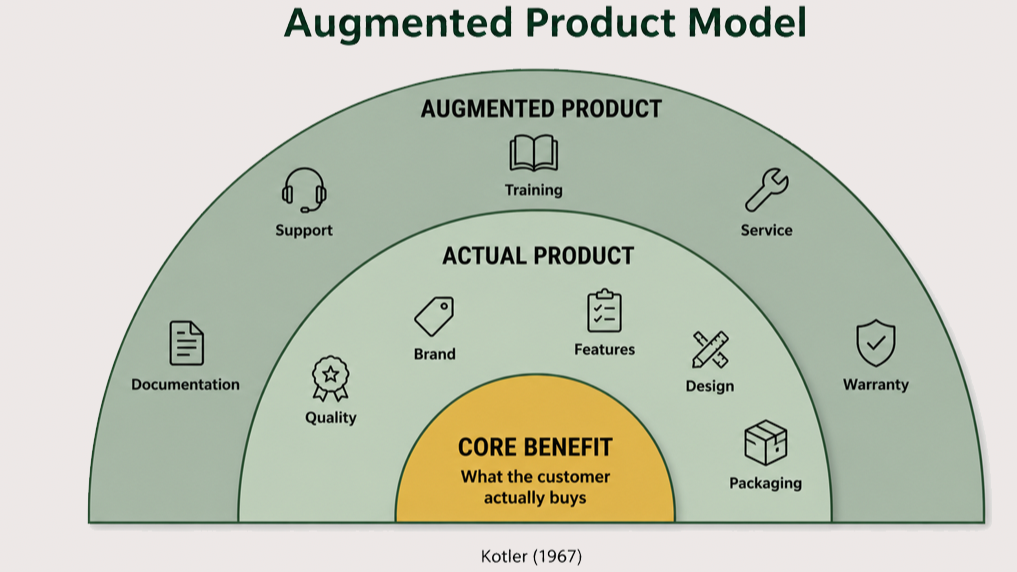
A team of entrepreneurs builds something genuinely differentiated. Early adopters come in on the vision, tolerate the gaps, and are eager to be the first to champion the technology. But then, when you reach beyond who knows you, the growth stalls, and the mainstream market doesn't follow. The instinct is always to blame the product — improve the assay, iterate the hardware, or add a new feature in the code. But the product isn't the problem.
Kotler mapped this decades ago with the Augmented Product Model. Every product exists at three levels: core benefit, actual product, and everything surrounding the core that makes it usable at scale.
Life sciences companies are exceptional at building the core. The reagent. The instrument. The assay. That's where the pure science lives, and that's where the talent concentrates. What gets neglected is everything else. Protocols that exist only in someone's head. No customer-facing application notes. No defined service model.
The gap between early adopters and mainstream customers is rarely a science gap. It's a product operations gap. Start-ups treat documentation and support structures as admin. As something to get to eventually. That "eventually" is one of the reasons the customer base is not growing.
The Augmented Product Model doesn't tell you to build more features. It tells you what's already keeping customers from buying what you've already built, and where to look first.
Apply it to your next commercial review
Next time you present your scientific innovation to a commercial team, try mapping it against the Augmented Product Model. Ask:
- Is our core benefit genuinely solving the customer's problem, or are we selling just new features or a good idea born in the lab?
- What aspect of your core product early believers tolerated but mainstream customers will demand?
- What augmented layers are missing that would make this product actually desirable at scale?
Tip: Doing this analysis with your commercial and R&D teams together often reveals the gap between what scientists consider "ready" and what customers consider "complete." The conversation alone can substantially improve your go-to-market strategy.
Reference: Kotler, P. (1967). Marketing Management: Analysis, Planning, and Control. Prentice-Hall.