 Bioicus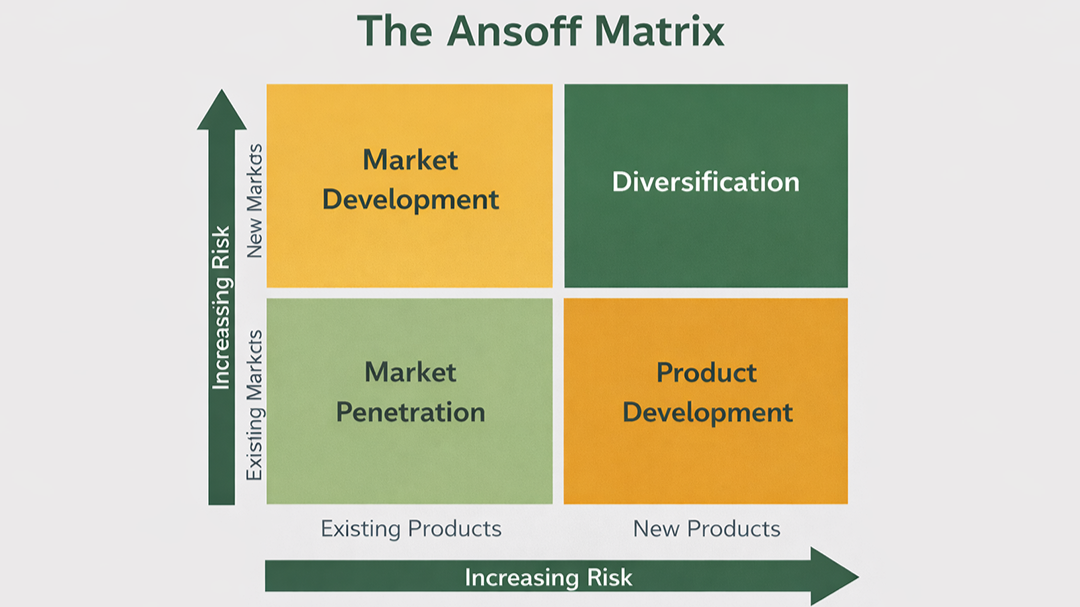
One of my favourite frameworks for rapidly assessing innovation proposals within a Life Sciences organisation is the Ansoff Matrix. Originally developed by Igor Ansoff in 1957, this classic 2x2 grid maps growth strategies across two fundamental dimensions: Products (Existing vs. New) and Markets (Existing vs. New).
For life sciences professionals, where investment in R&D decisions carries both significant capital requirements and long development timelines, understanding where a new idea sits on this matrix provides immediate clarity. It sets the stage for where the organisation's strengths lie: developing new markets or new products. Both are ideal, but rare.
The Risk Gradient
The matrix reveals a fundamental truth: risk increases as you move away from the X/Y=0, the organizational comfort zone. As you move to the right and up, risk increases.
1. Market Penetration (Existing Products → Existing Markets)
This is the lowest-risk quadrant. In Life Sciences, this often looks like operational management — developing new features for an approved drug, improving manufacturing yields, or optimising commercial execution. While essential for cash flow, this is often optimisation rather than disruptive innovation.
2. Product Development (New Products → Existing Markets)
This is often the preferred territory for wet-lab-driven innovation. You leverage your existing customer base in your safe therapeutic area to solve a known problem better, faster, or differently, possibly exploring a new regulatory pathway. Because the "Market" variable is a known constant, the learning curve is contained in the laboratory.
3. Market Development (Existing Products → New Markets)
Here, the innovation is commercial and regulatory rather than P<0.05. It involves taking a proven product and seeking new geographic approvals, paediatric indications, or repositioning it for a different disease state. The risk here lies in "market discovery" — the process of understanding a new set of stakeholders and competitors.
4. Diversification (New Products → New Markets)
When the ideation is released from the chains of operational and commercial feasibility, you enter Diversification. This is the highest-risk quadrant because it compounds uncertainty: you are building something you've never built for customers you've never served. In the startup world, this is where promising spinouts can burn through capital fastest. Success here requires simultaneous excellence in both R&D and business development.

The Colgate Beef Lasagna is a famous internet myth, but works as a good example of when innovation can go too far.
Practical Application in R&D Assessment
When a scientific team presents a novel concept, the first diagnostic question should be: "Where does this sit on the Ansoff Matrix?"
- Compounding Uncertainties: If the project requires both a novel scientific breakthrough AND the discovery of a new market, the probability of success drops significantly.
- The Conservative Bias: Many successful leaders favour "moving sideways" — innovating on one axis at a time. By staying within an existing market, you already understand the customer's pain points and the competitive landscape, allowing you to focus resources entirely on solving the technical challenge.
Two Paths to Growth
Innovation does not exclusively originate from the laboratory. The Ansoff Matrix makes this distinction explicit:
- R&D-Driven Innovation: Lives in the Product Development quadrant. It requires wet labs, clinical trials, and deep technical expertise.
- Commercially-Driven Innovation: Operates in the Market Development quadrant. It requires sales infrastructure, regulatory navigation, and market education.
Recognising which axis you are innovating on allows for better resource allocation and a more realistic assessment of the risk-to-reward ratio. The Ansoff Matrix doesn't tell you what to do. It tells you what you're choosing. When faced with multiple R&D proposals, this framework provides the discipline to ask: "How many uncertainties are we willing to stack simultaneously?"
Reference: Ansoff, H. I. (1957). Strategies for Diversification. Harvard Business Review, 35(5), 113–124.