 Bioicus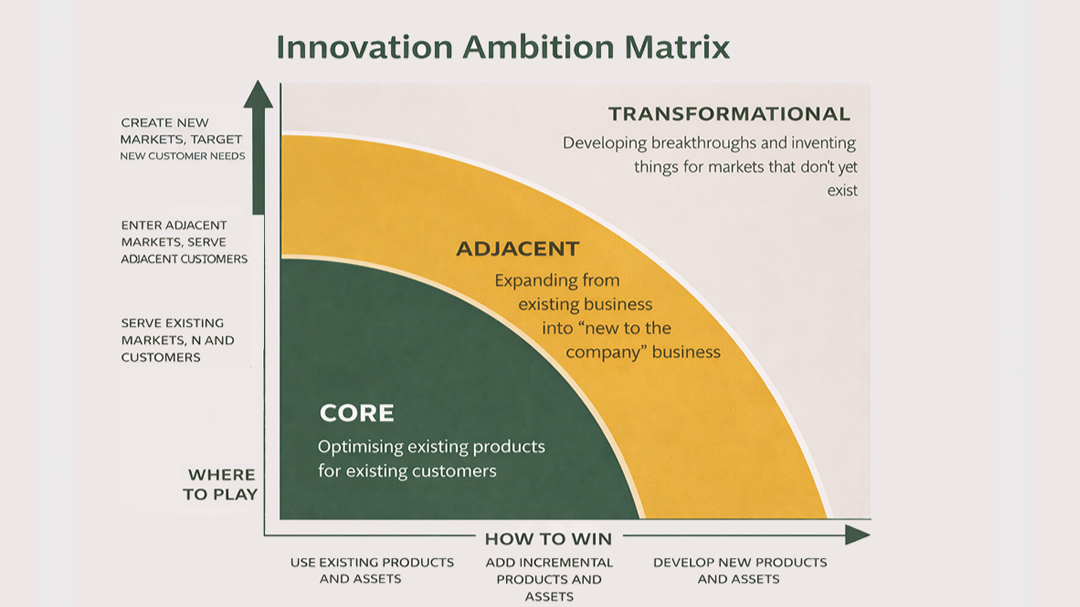
In my last article, I explored how the Ansoff Matrix helps life sciences professionals rapidly assess where an innovation proposal sits in terms of market and product novelty. It remains one of my favourites. But there's a follow-up question the Ansoff Matrix doesn't fully address: how ambitious is this innovation, and how should it fit within a portfolio?
That's where the Innovation Ambition Matrix comes in, developed by Bansi Nagji and Geoff Tuff, and published in their 2012 Harvard Business Review article "Managing Your Innovation Portfolio."
The Ambition Matrix builds directly on Ansoff's logic — Products on the X axis, Markets on the Y — but replaces the binary "existing vs. new" with a spectrum. Instead of four quadrants, you get three concentric zones:
- Core: Incremental improvements to existing products for existing customers. A better-performing antibody clone, a more efficient payload, a new feature on the analytics platform. Low risk, predictable returns.
- Adjacent: Expanding beyond your comfort zone into "new to the company" territory. It implies investing hours of learning and testing, serving a new customer base with unknown requirements, but still building on proven capabilities.
- Transformational: Heavily based on IP. New products for markets that don't yet exist. When it works, it can shake the industry in your favour. In life sciences, the moonshot.
Why it matters for life sciences
The Ansoff Matrix tells you where your idea sits. The Ambition Matrix tells you whether your portfolio is balanced.
Nagji and Tuff found a striking pattern across industries: companies that consistently outperformed allocated roughly 70% of innovation resources to Core, 20% to Adjacent, and 10% to Transformational initiatives. The inverse was true for returns, with transformational efforts generating disproportionate value when they succeeded.
Over-indexing on Core feels safe, but creates fragility. If 95% of your R&D budget goes into incremental improvements to existing kits, reagents, instruments, or services, you're optimising for today's revenue while quietly starving tomorrow's. When a competitor leapfrogs your technology — and in biotech, this happens — you have no pipeline to respond with.
Transformational bets require patience, which the industry often lacks. A novel spatial biology platform might take years before clinical adoption catches up. When product managers are measured quarterly, this tension is real, and the Ambition Matrix makes it visible rather than something people argue about in corridors.
Adjacent innovation is the overlooked sweet spot. Taking a well-validated immunoassay panel and adapting it for veterinary diagnostics. Repurposing a flow cytometry workflow for food safety testing. These moves leverage what the organisation already knows — proven chemistry, established manufacturing, existing regulatory knowledge — and apply it somewhere new. Lower risk than transformation, higher growth than Core.
My take: innovate on one axis at a time
As scientists, most of us were educated to win the Nobel Prize and transform the world. What nobody told us is that transformation is the result of endless incremental steps, not a single leap.
The Ambition Matrix makes this explicit: keep the transformational vision on the horizon, but allocate only around 10% of your resources there at any given time. Where I see companies get into real trouble is when a team proposes a new product for a new market simultaneously — new science, unknown customer workflows, untested commercial channels — all while burning through Series A capital, only because of a promising idea or freshly licensed IP. The probability of getting all three right at once is low.
A more resilient approach: innovate on one axis at a time. Take something you already make to a new market, or develop something new for customers you already understand. This isn't about being timid. It's about sequencing risk intelligently, which, for always capital-constrained biotech ventures, is often the difference between reaching the next funding round and running out of cash. And mental health.
Next time you review your product pipeline, try plotting each initiative on the Ambition Matrix. Ask:
- Where does our investment actually concentrate?
- Are we calling things "transformational" that are really just Core improvements with ambitious language?
- Do we have any genuine Adjacent bets, or are we stuck between safe and moonshot?
Tip: Doing this analysis together with R&D leadership can substantially improve the design of your product roadmap strategy. The conversation alone often reveals misalignment between what the lab considers transformational and what the market actually needs next.
Reference: Nagji, B. and Tuff, G. (2012). "Managing Your Innovation Portfolio," Harvard Business Review, 90(5), pp. 66–74.